Nashville, Tennessee: the gravitational center of country music. The home of the Grand Ole Opry. The birthplace of Taylor Swift’s career. The site of … the Tomato Art Fest?
Yes, the Tomato Art Fest: a festival of art, music, food, and much more, that draws tens of thousands of visitors every year to the Five Points district in East Nashville. Founded more than twenty years ago to celebrate the tomato as a “uniter, not a divider,” this community event has become a beloved feature of the Nashville scene (2026 edition: August 7 – 8).
Nashville’s Tomato Art Fest reminds us that every community—neighborhoods, towns, cities, regions, nations—has its own unique story. Some aspects of that story are well known (most people are aware of Nashville’s ties to country music), but some are not (did you know about the Tomato Art Fest?). Exploring a community’s story in depth can reveal additional detail and nuance of the well known, as well as bringing to light the lesser known.
In this post, I’d like to explore a little of Nashville’s story—both the well known and the lesser known—through a unique resource: library collections. And the window on that resource is OCLC’s WorldCat, the world’s most comprehensive database of information about library collections. As I’d like to show, information about the kinds of materials in library collections worldwide can shed light on an important part of a community’s story: its impact on the published record.
Insight into the well known …
Nashville’s ties to country music are, without overstatement, legendary. Many of the biggest country music stars have strong connections to the city. Consider the following sample:
- Taylor Swift: her family moved to the Nashville area to help her break into music.
- Patsy Cline: her musical style is a defining example of the famous Nashville Sound in country music.
- Johnny Cash: he’s a member of the Grand Ole Opry and recorded some of his biggest hits in Nashville.
- Willie Nelson: he moved to Nashville early in his career and became one of the city’s most noted songwriters; for example, he wrote the song “Crazy” that Patsy Cline made famous.
- Dolly Parton: her career started in Nashville—she moved there the day after she graduated from high school.
All of these recording artists are iconic pieces of Nashville’s story. But can we dig a little deeper and gain additional perspective on their impact on the published record? The answer is yes, through the window on the published record provided by data about library collections.
OCLC’s WorldCat aggregates information about library collections worldwide. More specifically, it can tell us two key pieces of information: the total global holdings of works by each artist, and the total number of holdings of works about each artist. A work can be any kind of published output: book, album, sheet music, and so on.
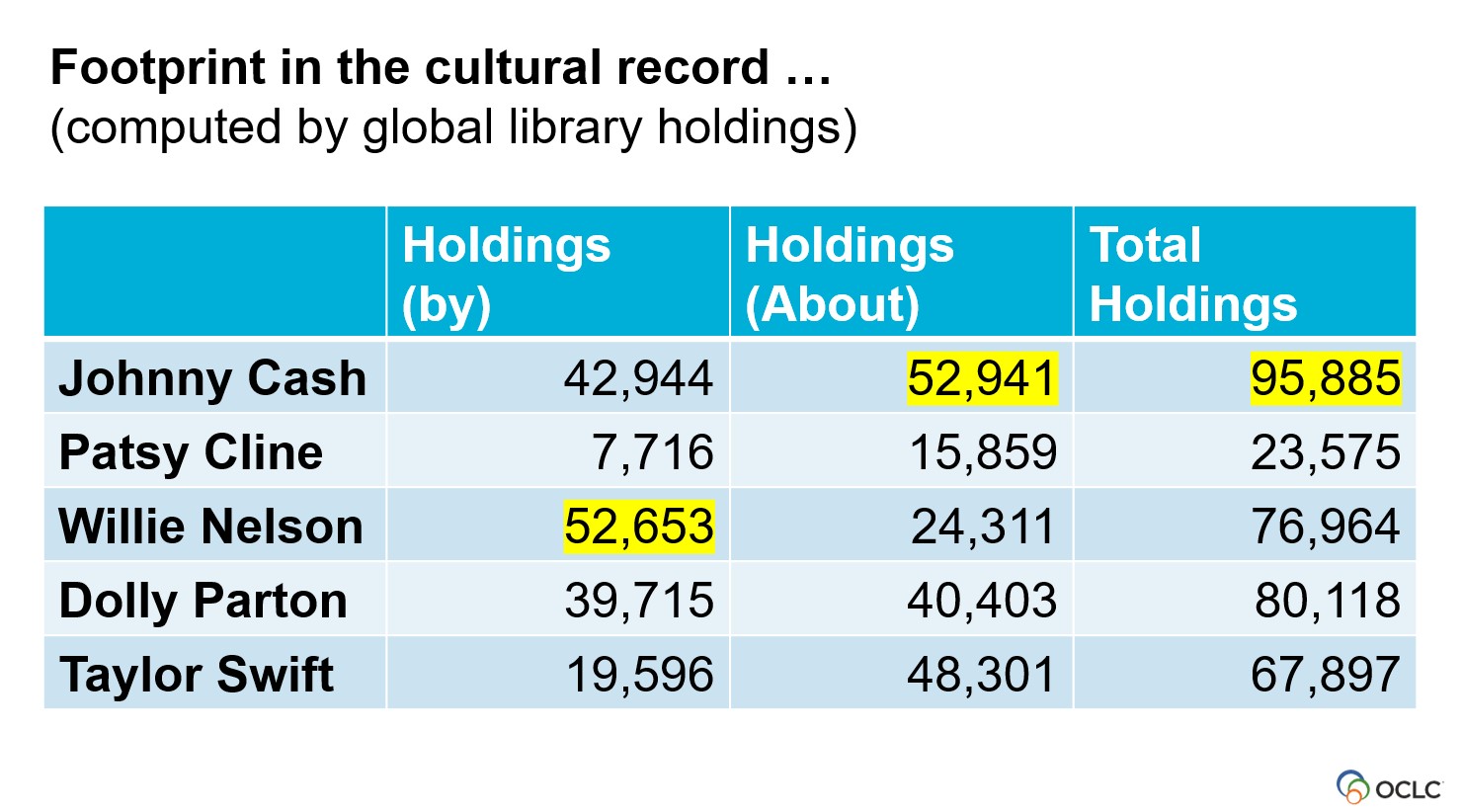
Here are the results. The data shows us that Willie Nelson has the largest footprint in library collections in terms of total global library holdings of works by these artists. But Johnny Cash takes the top spot for holdings of works about the artists. He also leads the ranking of overall holdings, suggesting that Cash has the largest impact on the published record among this particular group of artists.
It’s interesting to see that both Patsy Cline and Taylor Swift have far more holdings for works about them than for works by them, suggesting strong interest in their careers and life stories, in addition to their musical output. Willie Nelson is the opposite, with far more holdings of works by him than about him. This may relate to his prolific career as a songwriter both for himself and others. It’s also interesting to see that despite her as yet comparatively brief career, Taylor Swift is well on her way to equaling or eclipsing these legendary Nashville artists in terms of her footprint in the published record.
… and amplifying the lesser known
While many people are familiar with Nashville’s status as a hub for music and musicians, it’s also a publishing center. Need proof? WorldCat contains well over 9 million global library holdings of materials published in Nashville. Music publishing is of course important here—you’ll find many music publishers along Nashville’s famous Music Row—but Nashville is also a global center of the Christian publishing industry. HarperCollins Christian Publishing, one of the leading Christian publishers in the world, is headquartered in Nashville.
In addition to publishing, Nashville is also deeply connected to many prominent authors who were born, live, or work there. Consider these examples:
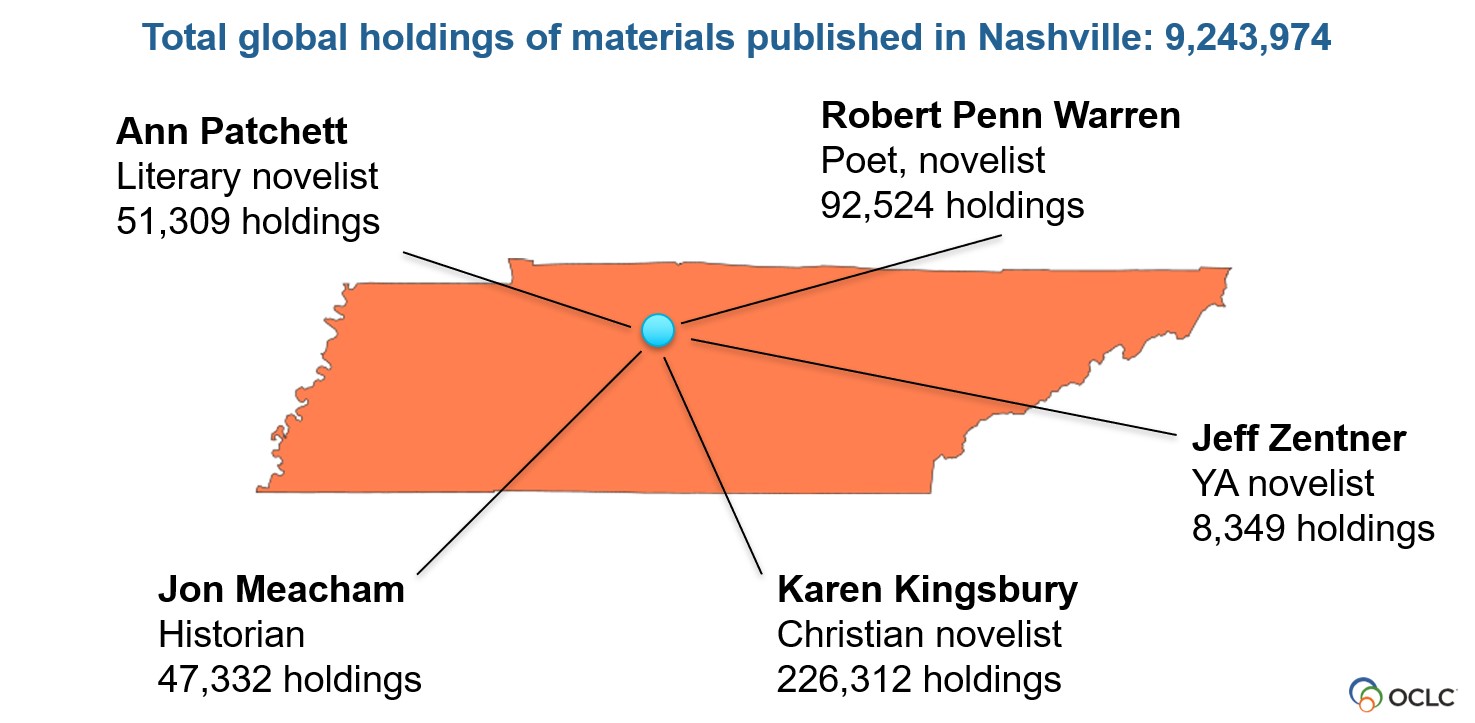
The novelist Ann Patchett, raised in Nashville and currently making her home there, was a finalist for the Pulitzer Prize in 2020 for her novel The Dutch House, a recipient of the US National Humanities Medal, and most recently, the 2026 Library of Congress Prize for American Fiction. WorldCat contains more than 50,000 holdings of her works in library collections worldwide. The poet and novelist Robert Penn Warren was both educated and worked at Nashville’s Vanderbilt University; among many other honors, Warren won a Pulitzer Prize in 1947 for his novel All the King’s Men, and the Center for the Humanities at Vanderbilt bears his name. Vanderbilt is also the home of historian Jon Meacham, who won a Pulitzer Prize in 2009 for his biography of Andrew Jackson.
We mentioned that Nashville is a global center for Christian publishing. The Christian novelist Karen Kingsbury, whose best-selling novels have more than 25 million copies in print, makes her home in the Nashville area, along with the headquarters of her production company. Note the particularly large global holdings total for Kingsbury, a testament to the remarkable popularity of her work. Young Adult novelist Jeff Zentner also resides in Nashville: his novel The Serpent King was named to Kirkus Reviews’ list of Best Books of the 21st Century (So Far). He has received numerous recognitions, including ALA’s William C. Morris YA Debut Award.
Each of these authors individually has a significant presence in library collections. But collectively, they form a community of accomplished authors spanning a wide range of genres and sharing significant ties to the Nashville area. Literary talent clearly flourishes in Nashville alongside musical talent—a key aspect of the Nashville story.
Find a city’s cultural influence—at the library
As these examples show, library data can deepen our knowledge of the well known (Nashville is a hub for country music stars) and illuminate the lesser known (Nashville is also a hub for authors and publishing). In both cases, library collections help us understand a community’s cultural influence through its impact on the published record.
The key to all of this is data aggregation. The data in a single bibliographic record, or even the data describing a single library collection, is not enough. It’s only by aggregating data about tens of thousands of library collections worldwide that patterns are revealed and the story emerges. Through its unequalled scale and depth, WorldCat is a unique source of information about global collections, and by extension, the global published record. It is within that expansive backdrop that we can find Nashville’s story.
The Tomato Art Fest is, I would imagine, a lesser-known piece of Nashville’s story. For many, it is an unexpected feature on Nashville’s cultural landscape, likely overshadowed by the music scene. In the same way, Nashville’s rich contribution to the published record across many literary genres may too be obscured by prevailing impressions of what the city is about. Library data helps us move beyond the surface and see a fuller picture—including a festival that celebrates tomatoes!

Brian Lavoie is a Research Scientist in OCLC Research. He has worked on projects in many areas, such as digital preservation, cooperative print management, and data-mining of bibliographic resources. He was a co-founder of the working group that developed the PREMIS Data Dictionary for preservation metadata, and served as co-chair of a US National Science Foundation blue-ribbon task force on economically sustainable digital preservation. Brian’s academic background is in economics; he has a Ph.D. in agricultural economics. Brian’s current research interests include stewardship of the evolving scholarly record, analysis of collective collections, and the system-wide organization of library resources.
By submitting this comment, you confirm that you have read, understand, and agree to the Code of Conduct and Terms of Use. All personal data you transfer will be handled by OCLC in accordance with its Privacy Statement.