
Status quo costs are the direct costs, risks, and missed opportunities associated with allowing existing arrangements to persist. Several recent OCLC Research studies spanning a range of library-related topics have highlighted status quo costs as a key aspect of library decision-making. The takeaway from these studies is that status quo costs shouldn’t be neglected; recognizing them helps overcome inertia and makes the true cost of inaction visible in decision-making.
In this post, I’ll introduce a simple framework for thinking about status quo costs in library decision-making. Accounting for status quo costs helps libraries make more informed choices by bringing the often-hidden costs of continuity into view. By explicitly addressing the costs of maintaining current arrangements, library leaders can weigh the pros and cons of change versus continuity more realistically.
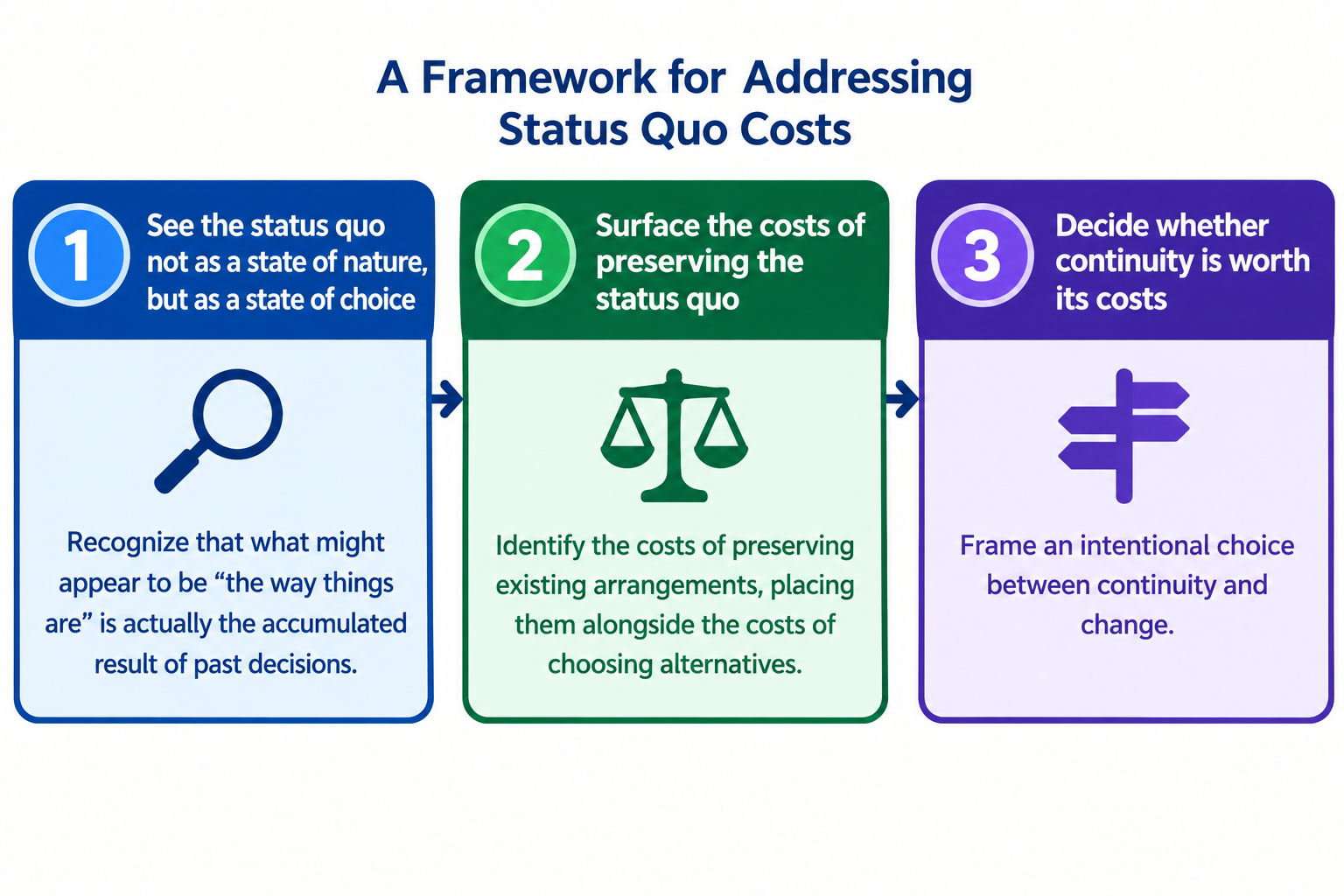
Status quo is a state of choice
The status quo is rarely an inviolable state of nature, or “the way things are.” Instead, the status quo should be understood as the accumulated result of past decisions based on conditions prevailing at the time: priorities, resourcing, technological capacities, and so on. Choices that were made under those conditions may have been optimal then, but are they still fit for purpose?
In the OCLC Research report Library Collaboration as a Strategic Choice, we frame the enduring influence of past choices using the concept of path dependency: the tendency for the status quo to continue because change is difficult to initiate. Path dependency is especially powerful when the choices involved in the creation of the current status quo gradually disappear from view. Over time, decisions lead to new routines, new routines become established practices, and established practices become unquestioned assumptions about how things should be. This makes the status quo seem inevitable rather than the result of earlier choices.
An anecdote from one of our earlier reports, Sustaining Art Research Collections: Case Studies in Collaboration, provides a compelling illustration of how path dependency, and the persistence of the status quo, can set in. A collaborative partnership between an art museum library and a nearby university library had, over the course of more than a decade, become routinized, and regular contact between stakeholders at the partnering institutions diminished. Routine, however, led to a lack of active management of the partnership, including regular evaluations of its progress or opportunities for adjustment or expansion.
This suggests an important lesson: decisions rarely are once and for all but instead should be revisited regularly as conditions and priorities evolve. This insight inspired one of the report’s recommendations: “One aspect of change management is having structures in place to regularly review the status of the collaboration and consider opportunities for expansion, course corrections, and other adjustments to the status quo. . . . Collaboration is an ongoing choice, not a one-time decision. Partners should continually and intentionally choose whether and how to collaborate.”
Whether the focus is library collaborations or something else, it is important to recognize that continuing the status quo is a choice that needs to be periodically reviewed and evaluated. This is a key first step toward loosening the grip of path dependency.
Surface the costs of the status quo
Once the status quo is visible, the next step is to make the costs of preserving it explicit.
All choices have costs. When the choice is change, the costs of adopting a new strategy are called switching costs. They may include necessary investments, steep learning curves, workflow disruption, and of course, the possibility of failure. These costs are very real, and library decision-makers rightfully take them seriously. In uncertain environments, switching costs often seem very apparent, even stark. In some cases, these costs are perceived as prohibitively high, producing a state of “lock-in”: the persistence of existing arrangements even when better alternatives are available.
Daunting as the costs of change may seem, the costs of preserving the status quo may be even higher. Maintaining the status quo can mean accepting ongoing inefficiencies, missed opportunities, and exposure to future threats. The challenge is to find a pathway through these competing considerations, a task which is often more art than science, shaped both by the magnitude of the costs involved and the decision-maker’s risk tolerance.
Accounting for status quo costs is vital for all types of library decision-making, including how to position an academic library within its parent institution. OCLC Research recently published the report The Library Beyond the Library, in which we make the case that academic libraries should engage more deeply with the broader institutional environment in support of research and learning. Increasingly, a library’s ability to fulfill its mission, retain influence, and demonstrate impact and value depends on that engagement.
For many libraries, this kind of engagement requires significant change in operational approaches. During an OCLC Research Library Partnership roundtable discussion on cross-campus partnerships in research support, many participants questioned whether a partnership-forward approach – an important pillar of the Library Beyond the Library framework – could work on their campus. They cited difficulties like the entrenched decentralization of the university environment and the pressure for individual units to demonstrate a distinct value proposition to campus leadership. These are genuine barriers to change, and overcoming them can involve substantial switching costs.
But the discussion also surfaced potential costs of continuing the status quo of providing research support services in isolation: diminished campus visibility; less impact; and ultimately, fewer resources. One participant provided a concrete example: on their campus, training workshops conducted in partnership between the library and another campus unit attracted far more attendees than workshops offered by the library alone.
By highlighting potential consequences of preserving the status quo, library decision-makers can see that maintaining continuity, while avoiding switching costs, nevertheless involves incurring other costs. And those costs can sometimes be higher than the costs of change.
Make the status quo a choice
Finally, make preserving the status quo an explicit choice. Place the status quo and its costs alongside alternatives (and their costs) to frame an intentional choice between continuity and change.
Once its costs are surfaced, the status quo is no longer a neutral state, but one option among others, with its own cost/benefit profile. This places the status quo on equal footing with alternative pathways—both need to be justified on the basis of their potential benefits and costs. It also counters the perceived inevitability of the status quo in the face of what might appear to be considerable switching costs for alternative options. The switching costs may indeed be high, but what matters is the comparison to the costs of maintaining the status quo. Evaluating these relative costs may reveal that continuity is the appropriate choice, but in this case, the status quo is intentionally chosen as the best option.
Making the status quo a choice could take the form of a periodic review, a set of established criteria triggering a change/don’t change decision, scenario comparisons, and so on. Consider this example from research data management. Once a data set is deposited into a repository, the tendency is often to let it remain indefinitely. But storage space is not infinite, stewardship consumes resources, and so the status quo of retention may not be optimal. The Illinois Data Bank counters this inertia by setting up an explicit choice about whether to continue retention. The Data Bank established a policy stipulating that retention of a data set is reviewed five years after deposit according to a defined set of criteria. Continuing the status quo—i.e., continued retention—therefore becomes an intentional choice within a clearly structured decision framework.
Another illustration is found in OCLC Research’s recent case study of the Portage Network, a collaboration among Canadian libraries to develop shared infrastructure and expertise for research data management. This included the creation of the Borealis Canadian Dataverse Repository, a shared repository that would supplant a number of existing local Dataverse repositories. In these cases, institutions made an intentional decision to move away from the status quo in favor of an alternative method of sourcing RDM capacity. The case study concludes that the status quo costs of maintaining a local Dataverse instance exceeded the switching costs of moving to shared infrastructure. What were the status quo costs? The cost of allocating staff to maintain local infrastructure was certainly a factor, but other costs were the levels of quality, efficiency, and speed foregone by retaining local repository implementations.
Making the status quo a choice is not a way to favor change over continuity. It is instead a way to avoid the pitfalls of path dependency, or a “this is how we’ve always done it” organizational ethos that may obscure better alternatives.
Counting the costs of continuity and change
The landscape of resourcing, staffing, technology, stakeholder needs, and much more is constantly evolving around libraries. In a dynamic and uncertain environment, library decision-makers need to recognize and evaluate both the costs of continuity and the costs of change.
What was once a choice can become entrenched as the status quo through time and familiarity. Making this visible, surfacing its costs, and deliberately reconsidering it alongside other options restores the status quo to what it should be: a decision.

Brian Lavoie is a Research Scientist in OCLC Research. He has worked on projects in many areas, such as digital preservation, cooperative print management, and data-mining of bibliographic resources. He was a co-founder of the working group that developed the PREMIS Data Dictionary for preservation metadata, and served as co-chair of a US National Science Foundation blue-ribbon task force on economically sustainable digital preservation. Brian’s academic background is in economics; he has a Ph.D. in agricultural economics. Brian’s current research interests include stewardship of the evolving scholarly record, analysis of collective collections, and the system-wide organization of library resources.
By submitting this comment, you confirm that you have read, understand, and agree to the Code of Conduct and Terms of Use. All personal data you transfer will be handled by OCLC in accordance with its Privacy Statement.